Blog Archives
Family Superpowers
 We write science fiction about characters with extraordinary gifts, gifts that most would say are impossible in real life. But when we look around at our family and friends, we notice that many folks have abilities that can only be described as superpowers. Here are some examples:
The Cuteness Factor. We’ve all seen this one. Sure, there are a lot of cute kids in the world, but some can focus that cuteness with amazing results. The world stops for them. Folks give them gifts for no reason. People trip over themselves to do things for them. They send their cuteness vibrations out into the universe and the cosmos rearranges itself to suit them. A Class-A superpower.
The Power of No. This is a good one. Folks with this talent can say no and others accept it. No explanations, no apologies. Just the one word and no arguments, thank you very much. Rare, but definitely powerful.
The Inability to See Dirt. An amazing skill, mostly possessed by men. Dirty dishes in the sink? Cobwebs in the corners? Mud on the floor? Nothing gets through the shield that prevents these guys, uh, people, from seeing dirt. Some are so powerful that even when the dirt is pointed out to them, they still cannot perceive it. Truly amazing.
Techno-demigod. What a great talent this is. The techno-demigod can simply sit down at a malfunctioning computer and it will immediately start working again. He can also perform this feat with other things, such as copiers, phones, and computerized appliances. A household and workplace deity.
The Finder. Finders are very useful. They can locate just about anythings. Can’t remember where you left your glasses? The finder knows. Where did you leave that important paper that you just had in your hand and now cannot locate anywhere? The finder will spot it within ten seconds of walking into your office. They have a knack of seeing what others do not and an ability to notice details that is super-human.
Moms. The superpowers of moms are many and potent. A sampling:
- The ability to see through walls and into rooms where their children are playing/arguing/plotting
- The ability to sense a fever/bruise/scratch or any other physical ailment in a child even if the child is not in the same state
- The ability to hear children who are playing/arguing/plotting even if the children are in another room
- The ability to freeze a person with her glance
- The ability to freeze a person or even an entire group with her voice (We wrote an entire blog about his one. See The Mom Voice.)
Are there any superpowers in your family?

Teenage Hearing
 We were worried about our daughter’s hearing. She’s sixteen and never seems to hear anything we say. Comments made to this kid are usually answered with “Hmmm?” Requests for her to do something invariably are met with “What?” And never try calling to her from another room. You will grow old waiting for a reply.
We were seriously considering getting her hearing tested when we began to notice inconsistencies in her hearing. One day we were in the kitchen pouring some crackers into a bowl when this supposedly deaf child suddenly appeared at our elbows.
“Can I have some?” she asked.
She had been in her bedroom at the other end of the house when she heard the crackers hitting the bowl.
Another time, we had opened a bag of pretzels and were sitting in the living room sharing them when we looked up and saw her standing there.
“How’d you know we had pretzels?” we asked as she dived into the bag.
“I heard you chewing,” she replied.
Or how about the time we were having an in-depth and lengthy discussion about a very special character in one of our books who needed to be able to communicate with other characters without giving too much information away, which would ruin the plot. We went back and forth for a good twenty minutes when our daughter called out from her bedroom.
“Make it communicate with feelings instead of words,” she said.
She had followed the entire conversation, which was taking place in the living room. And what was even more astounding, her suggestion was terrific. We used it, and it added a great dimension to the story. However, when we yelled back, “Thanks!”, we received no reply.
Sigh. Do you suppose there is a test for selective hearing in teens?
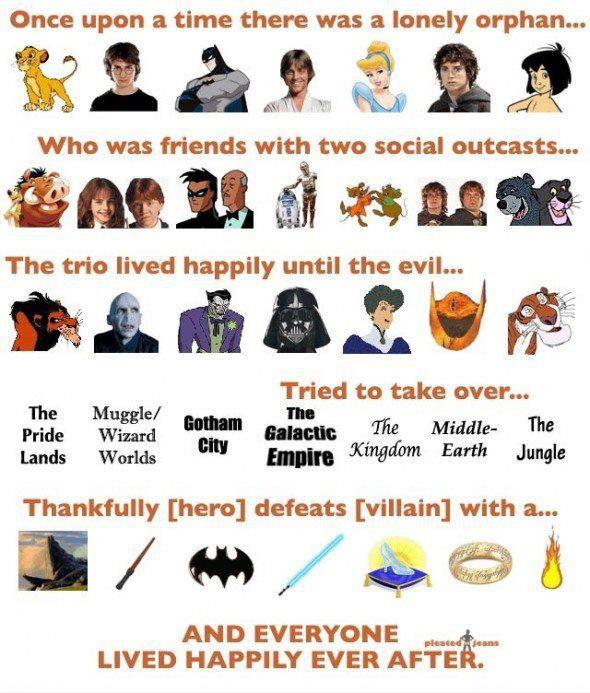
What Great Stories Have in Common
Ever feel deja vu when reading a book or watching a movie? Here’s why.
Thunder Paws
We’re not sure how many cats we have.
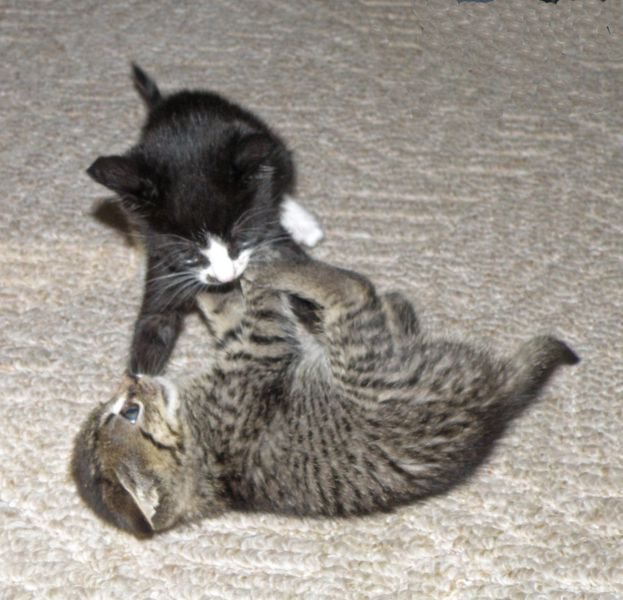
We thought we only rescued two kittens from the animal shelter. Two sisters, Katie, the gray tiger, and Zoe, the black and white. They were only a few weeks old when they came to live with us, too small to move beyond the bedroom door. But once they were older and did venture into that big world known as the rest of the house, a very strange thing happened.
The number of cats in our house multiplied.
The chaos and mayhem that has ensued over the last year has convinced us that we have more than two cats. It would defy all the laws of physics for two small cats to cause such commotion. Our evidence for this belief? The shredded curtains, the damaged blinds, the smashed glassware. The disconnected, well-chewed phone cord. The removal and shredding of all pieces of paper in our waste baskets. The sight of cats racing at a speed so fast they are just a blur, making it impossible to determine how many of them have just flown by.
We speculate that these cats come up through the drains. They creep in the open windows. They slither under the doors. The cat food bowls are always empty, the litter boxes always full. We are paying for far more cat food than two cats could ever eat. And as for litter box duties… Talk about job security!
Katie and Zoe deny any knowledge of the other cats. They stare at us with wide, innocent eyes when we make inquiries, as if they do not know what we are talking about. Sometimes they yawn, clearly indicating the questions are not important. And sometimes they casually saunter away, intending, we are sure, to warn the other cats to lie low because the food providers/box cleaners are getting suspicious. Then we laugh at ourselves. There cannot possibly be more than two cats in our house. Right?
We carry this false security to bed with us. We lie still in the night, listening to the sounds of thundering paws racing around the house, sounding like a herd of stampeding buffalo. To get up and investigate is dangerous. In the dark, a little, furry assassin will crack-block your ankles and then disappear, leaving you bruised and swearing on the floor. So we merely listen to the galloping, mentally calculating how many cats it would take to make that thundering noise. Calculating how much cat food we will have to buy. Calculating how many times we will have to scoop the litter boxes. We eventually fall into an uneasy sleep, each hoping that the rampaging hordes will not trample us in the night.
The Politics of Rocks
 We have a rock wall surrounding our yard and the four neighbors who share this rock border have four very different attitudes to the question of who owns the rocks on the wall.
Neighbor #1: “These rocks belong to me.” We simply cannot convince him that the property lines runs down the middle of the wall (several surveyors have also been unable to convince him of this) and, as a result, we are having constant skirmishes. This is our most volatile and unstable border. All negotiations have failed, and he now conducts regular border patrols. No leaves or sticks are allowed to linger on his lawn, either, and if you cross the border you so at your own risk.
Neighbor #2:“Take my rocks, please.” This neighbor doesn’t like the rock wall. The stones are constantly falling into his yard and causing mayhem when he runs over them with the lawn mower. He wishes to export as many rocks as possible, and we have a very liberal trade agreement with him. He barters rocks in exchange for help in repairing his lawnmower. Both our properties thrive from this mutually beneficial arrangement.
Neighbor #3: “Who cares about rocks?” The rock wall is not part of his vision of his property. He doesn’t care if we shore up the wall or take it down. His laissez faire attitude requires neither a trade agreement nor border patrols. It is an open border; kids freely cross it and rocks can be added or subtracted with impunity by either side (with the understanding that the wall itself is never dismantled). Free exchange at its finest.
Neighbor #4: “Rocks? What rocks?” We have a fourth neighbor, whose house sits behinds Mr. Take My Rocks, Please. His property shares the smallest section of the rock wall. He never exhibits any curiosity when we work on the wall, and when we once asked him if we could take a beautiful piece of quartz from his side of the wall and offered to replace it with a stone of equal size, he gave us a quizzical look and uttered the now-famous reply, “Rocks? What rocks?” It never even occurred to him that he had any claim on the rock wall. A Neighbor without Borders.
And how do our neighbors view us? We are not entirely certain, but we believe it goes something like this:
Mr. These Rocks Belong to Me sees us as a hostile nation and has instituted sanctions.
Mr. Take My Rocks, Please views us as a harmless border country with a different culture that is not understood but tolerated since our odd fondness for rocks supports his domestic policy.
Mr. Who Cares About Rocks probably views us as a neutral state. We don’t go to war with him and do not interfere in the politics of his nation.
And Mr. Rocks? What Rocks? Perhaps he sees us as a young country, building our infrastructure and cementing our borders. Perhaps he views us a materialistic nation bent on acquiring more wealth (in the form of rocks). Or perhaps, if someone were to ask him about us, he would reply, “Neighbors? What neighbors?”

Owls, Larks and the Writing Process
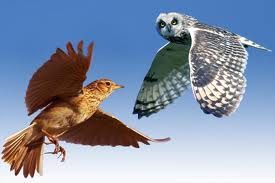 What do owls and larks have to do with writing? Well, when you are two authors writing under one pen name and one of you is an owl and the other a lark, finding the perfect time for writing sessions can be challenging.
For those who are wondering what we mean by owls and larks, we are referring to people who like to stay up late (owls) and those who like to get up early (larks). It’s annoying enough if you happen to be an owl married to a lark (or vice-versa) but things really get frustrating when owls and larks try to work together.
From an owl’s point of view, larks are those annoying creatures who rise and shine with smiles on their faces and a song on their lips. Very painful for any nearby owls who can’t help wondering what the irritating lark can possibly be so cheerful about at such an ungodly hour of the day. Larks think nothing of awakening an owl just as the sun is rising, eager to relate the fantastic plot idea they had during the night. Larks have the mysterious ability to wake up with their brains fully functioning. No warm-up time seems to be required. Owls just can’t relate.
A writing lark will often fly out of bed and head straight for the computer. The bubbly, oh, so sickeningly alert lark will then proceed to check all social networking sites, email accounts, etc., and call out interesting tidbits to the owl sleeping in the next room. The enthusiasm can be overwhelming to the poor owl, who dives deeper under the blankets in a classic owl-camouflage maneuver. The oblivious lark continues to chirp, unaware that her chatter is not even being processed by the sleepy owl brain.
From a lark’s point of view, owls are those annoying creatures who stay wake half the night prowling through the house and wanting to engage in animated book discussions just as the poor lark is trying to fall asleep. How anyone can be so full of energy after being awake for so many hours is a mystery to the lark who operates on theory that people should be full of energy after a good night’s sleep not just as they are going to bed. The owl flies in the face of such drivel, hitting his stride as the midnight hour approaches. Larks often wonder what they have done to deserve such a spouse.
Owls will often grab a yellow legal pad, turning on the bedroom light and jotting down several pages of notes on an upcoming chapter, repeatedly expressing their ideas to the lark, who, by now, has wrapped a pillow around her head in a standard lark-avoidance move. The owl, oblivious to such tactics, continues to hoot, his enthusiasm wasted on the nearly but, unfortunately, not quite asleep lark.
So what are owls and larks who work together supposed to do? We don’t know about other owls and larks, but twilight is our answer. The owl is truly awake and the lark has not yet begun to get drowsy. Thorny issues of character development and sticky plot problems can only be resolved during this magical time when both the owl’s brain and the lark’s brain are still firing on all cylinders.
The owl/lark problem is an old one, addressed by many writers and artists over the years. We’ll end with our favorite commentary on the issue by the legendary Charles Shultz in his wonderful cartoon “Peanuts”:
Lucy: Physicians can learn a lot about a patient by asking what may even sound like a very simple question. Which do you prefer, a sunrise or a sunset?
Charlie Brown: Well, a sunset, I guess!
Lucy: I thought so! You’re just the type ! I might have known that! What a disappointment! People who prefer sunsets are dreamers! They always give up! They always look back instead of forward! I just might have known you weren’t a sunrise person! Sunrisers are go-getters! They have ambition and drive! Give me a person who likes a sunrise every time! Yes, sir! I’m sorry Charlie Brown. If you prefer sunsets to sunrises, I can’t take your case. You’re hopeless! (She leaves.)
Charlie Brown: Actually, I’ve always sort of preferred noon!
 J.M. Dattilo