Category Archives: Writing
Writer’s Block
 Okay. We’re sitting here staring at a blank page wondering how to write the next chapter in our book. The page is staring blankly back at us. Not a thing is coming to mind. (Or in our case, minds.) We look at each other, hoping for that most elusive of all writing tools. Inspiration.
What to do when inspiration packs its bags and heads for the door? This is the nemesis of every writer we have ever spoken to or read about. The dreaded brick wall that brings all writing to a halt and leaves even the most intrepid authors with the feeling they will never have another creative thought in this lifetime.
How can two writers fall victim to this malaise at the same time? Shouldn’t one of us be bursting with ideas even if the other is having, what is euphemistically termed, an off day? Here’s the awful truth: Writer’s block can be contagious.
Nothing is more discouraging than a writer with tons of ideas who runs smack up against a writer who is suffering from a full-blown case of writer’s block. Here’s an example.
ANNOYING WRITER: (Bouncing into the room.) All we all set write?
CRABBY WRITER: (Giving Annoying Writer a look that should have caused a quick retreat.) Sure.
ANNOYING WRITER: I can’t wait to begin. I’ve got this great idea for that scene we’ve been stuck on. I know just how to fix it! It’ll be great. You see the 7-foot tall monster is really not a monster at all but a nice guy who is just doing his job. What do you think?
CRABBY WRITER: (Closing eyes against the sight of so much enthusiasm.) Swell.
ANNOYING WRITER: Don’t you like it?
CRABBY WRITER: It won’t work.
ANNOYING WRITER: Why not? It’s perfect! You see, the monster looks scary but is really…
CRABBY WRITER: I know. But it won’t work.
ANNOYING WRITER: What’s wrong with it?
CRABBY WRITER: We need the monster to attack the hero. (Pointedly.) Remember?
ANNOYING WRITER: Oh. Um. Yeah. But…
CRABBY: WRITER: There’s supposed to be a battle. (Pointedly.) Remember?
ANNOYING WRITER: Oh. Um. Yeah. But…
CRABBY WRITER: It’s a key element of the plot. (Very pointedly.) REMEMBER?
ANNOYING WRITER: Well, yeah, but I thought…
CRABBY WRITER: If we make the monster a nice guy, we’d have to rewrite the entire chapter. The monster would have to show up and then back off and the hero would be left wondering… Hmmm.
LESS ANNOYING WRITER: Yeah. I see your point.
LESS CRABBY WRITER: Actually, if the monster did that it would create a little mystery.
HARDLY ANNOYING ANYMORE WRITER: Maybe.
HARDLY CRABBY ANYMORE WRITER: We could leave it hanging and then have the monster unexpectedly show up in a later chapter and explain what happened.
BECOMING CRABBY WRITER: Explain what happened? Why should he do that?
BECOMING ANNOYING WRITER: Because it turns out he’s really a nice guy who’s just doing his job.
NEWLY CRABBY WRITER: I thought you said that wouldn’t work!
NEWLY ANNOYING WRITER: Why not? I think it’s a great idea!
And so round and round we go.
Is there a cure for writer’s block? Sure. There are any number of suggestions on the web and in books for breaking the block. Try a change of scenery. Switch to brainstorming. Take a walk. Learn to crochet. Any one of these ideas might work. Once, at least. However, the single best method that we’ve found for getting out of writer’s block is to write. Seriously. Write. Anything. Just start. Who cares if it’s bad? Who cares if it doesn’t make sense? Just spit it out. Force yourself. Yes, we can already hear the writing gurus screaming. But this works for us. We don’t necessarily keep what we write this way, but it gets us unstuck without fail. Once we get the bad stuff out of the way, the blockage loosens and the good stuff can come through.
So what happens when we both are just bursting with great ideas? Two annoying writers, of course. Our family members may avoid us, but we’re both as happy as we can be wallowing in over-enthusiasm and excitement and the thrill of creating.
Multitasking for Writers
 We’re all so busy these days. Computers, cell phones, social networking and all the endless gadgets of “convenience” have contrived to make our lives busier than ever. So, how do two hard-working authors find the time to write? Multitasking, that wonderful, terrible word that popped into existence approximately when all the time-saving gadgets began to appear.
Can you remember an era when we all only did one task at a time before moving on to the next? No, we can’t either. In fact, the only time when we’re not multitasking is when we’re sleeping and even then, before we fall asleep, we lie in bed planning our next day, plotting a new chapter, squeezing every last ounce of productivity out of the day before we close our eyes.
How can we write while doing other things? Isn’t that sort of complicated? Difficult? Downright impossible? Well, it depends on what part of the writing process we happen to be engaged in. The actual sit-down-at-the-computer-and-type part requires total concentration. We simply can’t multitask while writing a new scene and if any authors can, we’d like to meet them and learn their secrets. In our house a sure way to endanger your life is to interrupt the person who is in the middle of writing a chapter.
However, there is more to writing than just writing. Plotting, character development, creating interesting new places and beings, and coming up with made-up words to describe things that don’t exist anywhere else but in our imaginations are some of things we group under the activity we call writing. And these things, thankfully, can be done while working on something else.
For instance, we recently painted our living room, which could have been a drag, but actually provided us with large chunks of time to work on the book and kept us from getting snippy about all the work we had to do. Brainstorming new plot ideas took the place of berating each other about how the room should have been repainted five years ago. Creating a few new characters distracted from the klutzy one who kept spilling the paint. Deciding when and how to reveal the secrets hinted at in Time’s Edge was a welcome change from the one who who kept whining about sore arms and hands. All in all, multitasking was a lifesaver.
And take this winter. We live in New England. The first snowstorm hit December 26th (see our blog How to Write a Book During a Blizzard) and it pretty much snowed every week for the rest of the season. This meant we spent any spare time we had shoveling snow into drifts that rapidly became taller than we were. Instead of allowing this to eat up our writing time, we multitasked and discussed the book while shoveling. We solved a lot of plot problems and built up our muscles at the same time. The only downside was the odd looks we got from the neighbors when they overheard us talking about what to call a six-legged, lizard-type creature that has long claws and venom in its fangs. They must think we have a new exotic pet because none of them have dropped by for a visit since.
Of course, we multitask out of necessity, not for a love of it. There are days when we yearn nostalgically for the slowness of times past. No cell phones, no Internet, not even an answering machine for the phone. Ah, to have peace and freedom from instant connections, statistics, and promotions. To be able to sit back and let the world go by and just write while the only multitasking to be done is to make the tea when the kettle whistles. Paradise.
Statistics, The Curse of Social Networking
 Everywhere you go these days the unending varieties of social networking sites provide an equally unending stream of information. And the stats to go with them.
It’s all too easy to get obsessed by statistics. You start out with your very first page. The site very helpfully provides information about how your page is doing, how many people have visited, how many have left comments or liked your page. Instant feedback. How nice! And at first it’s fun. Look! We had ten visitors! Ten! Isn’t that amazing? Ten more people now know about us! (And then you learn that the ten were your parents, siblings and a cousin, the one you can’t stand.)
You then begin to worry. Why only ten? We have to do better. You scan other pages, looking at the hundreds and thousands of fans and comments they have. How in the world does L.L. Bean do it? What does Madonna have that we don’t? Gee, Stephen King only has to write the first few pages of a new novel and the world beats a path to his page. You read other blogs, trying to fathom the mysterious secret, the magic combination that sets them apart and earns them such avid readership.
Well, you decide, if they can do it so can we. You try to determine how to get the most hits. What brings people to your page? What gets the most likes and comments? You experiment, try new things and often end up scratching your head at what works and what doesn’t. (Like the time we simply could not think of anything to blog about so we quickly wrote a spoof of A Visit from St. Nicholas which we called Twas the Night We Were Blogging. It has been our most popular blog to date. Go figure!)
Soon you are checking your stats daily. Are they up? Hooray! Down? Oh, no! Unchanged? WHY? Is the darn site glitching again? You start questioning yourself. Wondering. Worrying. Trying to come up with something new, something entertaining, something… Well, if we knew what the magical something was, we’d do it! And you still keep anxiously watching those stats.
It is not long before you are sneaking peeks at your stats a few times a day. Just a quick look. Just want to see if we’re doing better/worse/the same than we were this morning/this afternoon/this evening/ten minutes ago. Any new fans on Facebook? 55? Yea! We got a new one. You dance an Irish jig around the office until your significant other comes in and says that you already had 55 fans. You insist it was only 54. And you spend the next half hour arguing over that one fan, who is probably your cousin, the one you dislike.
Book sales are the worse type of all the stats. The figures change hourly. You can be selling in the top 2% one hour and drop down to 10% in the next. It’s worse than watching the stock market and just as unpredictable. When your sales are soaring you wonder (amid the cheering and fist-pumping) just why the world has suddenly flocked to your book. Was it the blog? Did they see the trailer on youtube? Perhaps it was the promotion on Goodreads? Just what in the world did we do to make this happen and how can we keep doing it? Unfortunately, when sales are dropping, you wonder the same things, in reverse. Didn’t anyone read the bog? Can’t they find the trailer on youtube? Is the Goodreads promotion just not enough? What in the world did we do to make this happen and how can we stop doing it?
Statistics obsession eventually reaches a peak. After the roller coaster of ups and downs, you chill out, knowing that your rankings can and will change at the drop of a hat for reasons unknown. It could be the phase of the moon. Or the stars might not be in the right position. Or perhaps your cousin, the one you dislike, has a big mouth and a lot of friends, which, for once, has worked to your advantage. Or maybe, just maybe, it was that last blog/Facebook post/book trailer/promotion that did it this time. Hmm. Perhaps we should check those stats again and try to figure it out…
Please Folks, Don’t Try This at Home
 Where do ideas come from? Mostly, they seem to appear out of thin air, but sometimes they can have far more real sources.
Picture this: A man and a woman are hiking in a park. The man suggests leaving the trail to climb up the side of a waterfall. The woman is dubious. The man assures her he has made the climb before and it is safe and easy. Against her better judgment, the woman agrees to give it a try. They begin to climb. Halfway up the steep, slippery, safe and easy side of the waterfall, the woman slips. She dangles from the rock above, the man gripping her hands. Below her are some very large, very pointy and very solid-looking boulders. She looks up into the man’s eyes. “I love you,” she says. “But if you drop me, I’m going to love you less.”
Yes, this really happened to us when we were dating. Years later, this event became the inspiration for a scene in Time’s Edge. The hero and heroine wind up dangling off a suspension bridge over a rocky gorge. Not an exact translation, but the spirit of the original adventure is there. And it wasn’t the only time a real-life situation inspired us.
On another pre-marriage outing, we decided to go to a local beach. The tide was out and we wandered far from shore collecting rocks and shells, blissfully unaware that the tide was not going out but coming in. By the time we did realize what was happening, there was a large channel of water between us and the shore. As the tide rolled in, we frantically hopped from one shrinking sandbar to the next before Joe finally pointed out it was time to sink or swim. We plunged into the icy waters (it was April on Long Island Sound, not a warm time of year for a dip) and made it to shore, soaked and freezing. As we stood on the shore waiting for feeling to return to our bodies, Joe said, “That would make a good scene in the book!” He nearly got tossed back into the water. However, years later, our icy swim has resurfaced as a scene in Time’s Illusion, the third book of our series.
Does this mean we have fallen through mysterious dark doorways into other times or that we’ve been accosted by a seven-foot tall monster? Nope. Our imaginations work just as well as any other writers. However, real-life events do have a way of working themselves into our tales, albeit in a roundabout way. We’ve been lost in the woods, trapped in an elevator, stuck on a cliff ledge and stranded on a roller coaster. (We hope our mothers aren’t reading this.) And do these things happen to our characters? Not exactly. What we tend to do is latch onto the feeling of the event, the emotion and adrenalin and underlying humor that always seems to infuse the mishaps of our lives.
Of course it’s not just outdoor adventures that inspire us. Mary’s close encounter with an MRI is a good example. There she was lying on the board that slides into the closed tube (no open MRIs in those days!). She had been injected with a strange substance by the evil attendant who then ran away to his safe, radiation-free booth. His voice crackled over the microphone that he used to communicate with his victim…um, patient. He cheerfully told her that if she began to feel uncomfortable she could just squeeze the blue ball that was attached to a wire. This would let him know there was a problem. She had the ball in her hand and lifted it to make sure it was connected. It wasn’t. As she realized she had no way to communicate with the owner of the voice, she looked up to see a yellow smile face sticker grinning down at her from the top of the tube, which seemed at the moment to be a fine sadistic touch. She stoically endured the session and emerged from the tube with red, blotchy skin because she was having a reaction to the injection. The attendant came out from his room with a big smile and proclaimed, “That went well! By the way, you seem to have a sinus infection.” She prudently left before she gave in to her desire to punch him in the nose.
This experience became a scary scene in Time’s Secret. The MRI became a torture device in a place called the Inquisitor’s Chamber, and the attendant became a villain who is eager to demonstrate how the machine works. (For those who are wondering, the smile face sticker didn’t make it into the scene.) All the emotions of the actual event are there and the resolution… Well, the book isn’t published yet, and we don’t like spoilers, but we will say that getting even with evil MRI attendants can be fun.
Twas the Night We Were Blogging
 ‘Twas the night we were blogging, when all through the house
Not an idea was stirring that would inspire a mouse;
Our manuscripts were flung by the chimney without care,
In hopes that inspiration soon would be there;
We wished we were nestled all snug in our beds,
While visions of blog stats danced in our heads;
And my wife in frustration and I in despair,
Were beginning to think we had nothing to share.
When out of the blue I got a great notion,
I sprang from my chair in a whirl of commotion.
Away to the computer I flew like a flash,
And opened the program but the thing promptly crashed.
I pounded the keyboard, right-clicked the mouse
Then uttered a yell that was heard through the house.
When what to my wondering eyes should appear,
But a Microsoft message that wasn’t too clear.
It’s an outdated driver, so slow and so sick,
I knew in a moment this wouldn’t be quick.
More rapid than eagles our curses they came,
We stamped, and we shouted, and called it some names;
“Now, Damn it! now, Darn it! now, How do we fix this!
Oh, Blast it! How stupid! oh, How do we nix this?
This is taking too long! We’re climbing the wall!
Just go away! go away! go away all!”
As frustration did grow and our tempers did fly,
We met with the obstacle, and said “Do or die!”
So back to the keyboard my fingers they flew,
With determination, and disk repair, too.
And then, in a twinkling, I saw on the screen
Another message from the hateful machine.
As I threw up my hands and was starting to frown
Error messages appeared with a bound.
They made no sense to me and no sense to my wife,
And had but one purpose; to cause us much strife;
A bundle of codes, which took us aback,
And made us believe we were on the wrong track.
Our eyes — how they twitched! our faces weren’t merry!
Our cheeks were like roses, our noses like cherries!
My wife’s little mouth was drawn tight as a bow,
And the look on her face as cold as the snow;
I turned to the screen and gritted my teeth,
The steam from my ears circled my head like a wreath;
I felt a sharp pain deep in my belly,
And was beginning to shake like a bowl full of jelly.
I grabbed a manual from off of the shelf,
And mumbled and murmured and read to myself;
My wife caught my eye and then shook her head,
Which let me know I had plenty to dread;
I spoke not a word, but went straight to my work,
And fixed all the problems; then turned with a jerk,
And giving the finger to the stupid machine,
I started it up and it worked like a dream!
My wife sprang to the keyboard and began typing away,
Creating a blog to post the next day.
But I heard her exclaim, as we finished that night,
“Blogging can be quite fun, but sometimes it bites.”
(With apologies to Clement Clarke Moore)
Fictional Characters Are People, Too
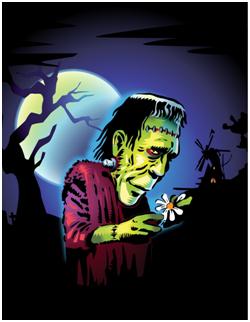 As any writer knows, characters in stories tend to take on lives of their own. You give them eye and hair color, personality traits and quirks, a background, possibly a few talents. Then, like Dr. Frankenstein, you stand back and watch your creations come to life. And, like Dr. Frankenstein, you sometimes discover that creations can behave in entirely unexpected ways.
We put a lot of work into creating characters for our books. We keep a notebook devoted to characters, detailing everything about them from physical descriptions to histories to favorite foods. Many of the details never actually make it into the stories, but they do help us create more fully developed characters who behave in ways consistent with their personalities and backgrounds. We talk about them as if they were real people and just like real people, they do not always follow the nicely constructed plot of their lives.
Nothing blows a hole in a plot faster than a character that just won’t react in the way we had planned. This shows up right away when trying to write a scene that requires a character to behave in a way that, well, just doesn’t suit them. The scene stumbles along, sputters and then stalls. We read it over, trying to determine where the problem is. Invariably, one of the characters is being difficult.
For example, Kate, one of the main characters in Time’s Edge, was supposed to reveal some of her secrets to Michael, the hero of the story. Unfortunately, we couldn’t make it happen. No matter which way we wrote the scene, it was awful. Stilted. Unnatural. We finally realized she just didn’t want to reveal her secrets. She came from a family who had learned her secrets and treated her very badly because of it. She had spent her entire life hiding and trying to pretend that she was just like everyone else. She wasn’t about to spill her guts to Michael or anyone else. He would just have to discover her secrets for himself, a job it turns out that he was very good at. A whole new sub-plot developed that gave us a much more exciting and interesting tale.
And that is the strength of listening to characters. Like children (or monsters, if you prefer the Dr. Frankenstein approach), they go their own ways, think their own thoughts, live their own lives. Sometimes they’re logical, sometimes they’re not. They can be maddening, like when they insist on doing stupid things (ie: Michael dives head first through a dark doorway even though we all know he’s headed for disaster, but Kate is in trouble and he’s not the type to let a little thing like looming disaster get in his way!) or, worse, when you need them to do stupid things and they simply won’t (ie: Kate refuses to go through a dark doorway because she’s a seer and knows too darn well what’s waiting for her). She just knows better, even though you need her to do the dumb thing in order to further the plot.
Fortunately, characters have no idea where the plot is going and that’s very good. It frees them to be themselves. They don’t have the tunnel vision that comes from believing a story must unfold in a particular way. They are living the story, reacting as it develops. It’s a little bit like living in the Twilight Zone. We create characters and then they come to life and insist on behaving in ways we can’t seem to control. All we can do is provide them with interesting situations and then see what they do. We basically follow them, recording their experiences as they wander through the worlds we have created. Sometimes their reactions can lead the tale in new and wonderful directions and sometimes it can leave us wondering why we created these unruly beings to begin with. So here’s to Dr. Frankenstein and Rod Serling. We think they’d both understand how we feel.
Why Husbands and Wives Should Have Separate Offices
The home office. As common in houses today as a kitchen or bath and just as necessary. Remember the days when a home office was rare? A luxury? A nice, but, gee, do we really need one type of thing? Older folks will be smiling, younger ones will be scratching their heads, unable to envision such an archaic time period, let alone imagine what life would be like there. But, yes, the home office was once a lovely little extra, stashed away in a closet or corner of the kitchen or, if you were really lucky, a spare bedroom or den.
In our house, the office evolved right along with the rest of American home offices. Our first “office” (if we can apply that term to such a modest space) was in our kitchen. It was just a desk with a computer on it, stuffed in a corner and we had to sidle around it to get to the back door. This wasn’t really conducive to writing. For one thing, the traffic in the kitchen was annoying. It was an eye opener how often our family was in search of something to eat. It certainly explained the grocery bills! For another, boiling pots and a hot oven raised the humidity and temperature to a point that the printer, over-taxed from the strain of trying to push out steam-cooked pieces of paper, spit out its gears at us one day and expired.
A move from that two bedroom condo to a three bedroom ranch provided us with our first real office. How wonderful, we thought. An entire room dedicated to an office. No more traffic, no more humidity, no more manuscripts stained by tomato sauce or grape juice. We were in home office heaven. Until we both tried to exist in this same space, that is.
The first problem was that Joe was running his business from the same office. Trying to get any writing done during business hours was not only frustrating but painful. Imagine trying to write a scene where the main characters are dancing together for the first time. You can hear music playing, see the room, brilliant and sparkling, feel the motion of the dancers, while, in the background, an angry man is shouting into a phone at a supply house because his orders are two weeks late and his customers are rioting.
Another problem was that we only had one computer and three people vying for it, one of whom was a teenager. A typical evening: Husband sits down, determined to please his wife, who is suffering from eyestrain trying to read his handwriting, and actually write a chapter on the computer. (He always writes on a yellow legal pad. See previous blog.) Aforementioned wife comes in and asks if she can quickly check her email. She proceeds to check two email accounts, her Facebook page, their joint Facebook author page, the blog stats, and all book and play sales reports for the day. Husband hangs around for a few moments but decides to go get a snack when wife gets annoyed at him for reading over her shoulder. He comes back just as wife is finishing and sits down again. Teenage daughter bops into the room and reminds him that she has an English paper that she needs to finish. Dad asks how long she will need the computer. She replies an hour or two. Dad sighs and goes in search of a yellow legal pad.
Then there was the issue of writing preferences. Joe is what we call a social writer. He shares as he goes along, reading bits of newly written scenes out-loud and reading over his wife’s shoulder while she writes and offering comments and critiques. Mary is a private writer. A don’t-read-my-stuff-until-I-want-you-to writer. An I’m-trying-to-think-will-you-please-be-quiet writer. An if-you-don’t-stop-reading-over-my-shoulder-I’m-going-to-kill-you writer. You can see how things can get a bit tense.
Even office organization was a problem. Mary likes a neat, orderly writing environment. A place for everything and everything in its place. Simple. Clean. Efficient. Joe loves an office that requires a team of archaeologists to discover where that last scene he wrote is. His theory is out of chaos comes order. It was like Felix and Oscar sharing a room. It became apparent that we had to have separate spaces or end up in home office counseling.
So now we each have our own office. Mary’s is in a very nice finished corner of the basement, tastefully outfitted, organized, and peaceful. A veritable home office oasis and far enough away from Joe’s office that irate phone calls cannot be heard. Joe’s office is in the extra bedroom, filled with gadgets, satisfyingly messy, and totally comfortable (if you’re a guy).
We always respect each other’s space, not out of any special consideration for the other, we must admit, but for good practical reasons. Mary never leaves her stuff in Joe’s office because she knows she’ll never find it again. Joe never leaves his stuff in Mary’s office because he knows she’ll throw it out.



Not All Those Who Wander Are Lost. Some Are Just Looking for Their Glasses.
Sitting down to write a book isn’t as easy as, well, sitting down to write a book.
The process of getting two writers to sit down and write at the same time can be arduous. First of all, as most married folks know, getting a husband and wife to agree on what they want to do at any given moment is a feat all by itself. He suggests doing some writing before dinner. She points out that although she is a multi-tasker extraodinaire, cooking and writing simultaneously always results in a burned dinner. She suggests writing after dinner. He has a meeting, which is why he suggested writing before dinner. So they sit down to write and the dinner burns.
As any writer knows, writing is a daily activity. If writers waited for the perfect mood, they’d never write anything. Finding that idyllic place, the yeah-this-stuff-is-rolling-out-of-my-brain-just-as-fast-as-I-can-type moment, is rare. Having two people hit that high at the same time is even rarer. It’s much more common for one to be ready to write and the other not interested at all. Sort of a “not tonight, I have a headache” type of thing. This is where scheduling writing time comes in handy. It’s like making a date. You look forward to it, you prepare for it and (hopefully) you score.
And let us not forget our writing tools. Is it a plotting session? Then lined yellow pads and pencils are needed. Editing? Red pens are a must! Plus a lot of tea. And maybe something stronger if editing gets really brutal. Actual writing? Here we differ. Mary writes on a computer, Joe, the old fashioned way, long-hand on a legal pad. That makes combining scenes LOADS of fun. Deciphering Joe’s handwriting is not for the faint of heart. Not to mention having to print a half written scene from the computer, adding long-hand notations, and then transcribing the whole thing into a workable (and readable) draft. Yikes!
A place to write is important, too, and also depends on what we happen to be doing. We edit at the kitchen table because editing needs a lot of room, not only for spreading out various drafts and scenes but for ducking if someone throws something. Plotting needs atmosphere. The gazebo in summer, by the fireplace in winter. Sounds lovely, doesn’t it? It can be and plotting a storyline can be a lot of fun. (When you’re not banging your head on a table because you can’t figure out just how the heck you’re going to get out of the corner you’ve written yourself into, this is.) And the actual writing? We need separate spaces for this part of the job. In fact, this is so important we have another blog coming devoted just to this topic!
Finally, and most importantly, we both wear reading glasses. This is a problem, because, as anyone who wears reading glasses knows, there is a special law of physics that states that reading glasses are never left in the same spot twice. The joke in our house is that we need glasses to find our glasses. Writing sessions are often delayed as one or the other hunts for our glasses. No glasses, no writing. So we wander from room to room, wondering where we left them, wondering if someone else could have moved them, wondering if we have gnomes who come out at night and hide our glasses. And that brings us to the moral of our story. Not all those who wander are lost. Some are just looking for their glasses.
(J.R.R. Tolkien’s birthday is January 3rd. His book, The Fellowship of the Ring, is the source of the “not all those who wander are lost” quote. The full quote goes: “All that is gold does not glitter, not all those who wander are lost; the old that is strong does not wither, deep roots are not reached by the frost. From the ashes a fire shall be woken, a light from the shadows shall spring; renewed shall be the blade that was broken, the crownless again shall be king.”)
Tolkien, apparently, never had any trouble finding his glasses.

How to Write a Book during a Blizzard
Ah, a blizzard! The perfect excuse to stay home and write. There will be hours of uninterrupted time. Time to start a book! Finish a book! Plot another book! Here’s how to go about it.
Step one: Wake up and discover that the storm predicted to go out to sea the night before is barreling toward your location at the speed of Concorde jet. Wake up husband and then madly dash to the kitchen to make sure you have enough food. Sigh in relief when you discover you do. Before complete relaxation can take hold, realize that you have no cat food and the cat is already staring at you as if you were a hamburger and she knows where the ketchup bottle is. Husband lies in bed wondering why he is awake so early on his day off.
Step two: Ignore grumbling husband, get dressed and cleverly drive to small, local market to avoid the panic at the grocery store. Discover that the store does not open until 10:00 because it is Sunday and the day after Christmas. Start swearing and drive to the larger store. Circle the parking lot like a shark as you search for a parking place. As someone pulls out, step on the gas and pull into a space ahead of two other cars trying to do the same thing. Pretend you don’t see them saluting you.
Step three: Head to the deli because your ultra-fussy cat won’t eat regular cat food. Grab a number. Forty-one. Look up at the “Now Serving” number. Two. Swear. (Don’t worry about the people standing near you. They will be swearing, too.) Wait for forty-five minutes to get a half-pound of sliced chicken breast and a half-pound of sliced turkey. Go stand in three mile-long check-out line. Fume. Pay. Walk through parking lot with three cars following you in hopes of snagging your spot. Narrowly escape with your fenders intact. Ignore the sound of the crash as you drive away.
Step four: Return home to find your now awake husband outside frantically taking down Christmas decorations so they will not be destroyed in the storm. Regret having awakened him and then stomp inside and trip over the cat. Feed the furry little demon and stomp back outside to help. Return inside one hour later with frost-bitten fingers. Upon observing your frozen-in-more-ways-than-one expression, husband wonders why he is awake so early on his day off. Stare at the tangle of lights littering your kitchen floor and puzzle about where you are going to store them since they never fit back inside their boxes. Get trash bag, shove all decorations inside, toss into a corner of the basement and decide to worry about it next Christmas.
Step five: After thawing frozen fingers, go in search of your husband (and writing partner). Look in his office. Bedroom. Bathroom. Garage. Where the bleep is that man? Find him in the basement. He explains that since it is snowing it will be a great day to clean out the basement. Explain that you thought it would be a good day to write. He explains that he is already involved in the project. You explain that you really, really want to work on the book. He looks dubiously at the piles of magazines and boxes surrounding him. You refrain from asking why he didn’t clean the basement all the other times you asked and has to do it NOW. He wonders why you aren’t excited about him doing something you have been after him to do and once again asks himself what he is doing awake so early on his day off.
Step six: Be more convincing. Suggest lighting a fire and making tea. Mention Christmas cookies. Finally say, “I. Want. To. Work. On. The. Book.” Husband finally understands that you want to work on the book rather than clean out the basement. Both stomp back upstairs.
Step seven: Channeling the anger, irritability and general grumpiness of both parties you plot a killer battle scene for your new book. And a great argument chapter for the hero and heroine. Work up a nice episode of evilness for the villain. A planet explodes. Someone threatens the galaxy and then the universe. Then spend the remainder of the time arguing about irrational character motivations and illogical thought processes because no one in real life would ever act THAT WAY.
Step eight: Realize it is probably going to snow for another 24 hours. Decide the cat has the right idea and a nap in front of the fire is a really good idea. Ignore husband’s that’s-all-I-wanted-to-do-today-anyway look.


So, How Do Two Authors Write as One?
 It’s the question we are asked most frequently. How do two people write one book? How do we create the plot? Write the chapters? Achieve one voice? And (the most frequently asked question of all) how do a husband and wife manage to do all this without killing each other?
The answer: it ain’t easy! At first, actually, it was easy. When Joe was in college he had a great idea for a story. He met Mary, who loved to write. We met twice a week, on Wednesdays and Sundays, to plot the book and flesh out the characters. We decided to write alternate chapters, Joe chapter one, Mary chapter two and so on. And it worked great for awhile. Then we hit a major stumbling block. We got married.
Who would have thought that living at the same address would put such a crimp in our writing? But it did. We were managing a household. We acquired two cats. Three years later the baby arrived. It’s not that we were busier than when we were in college. We both had carried full course loads, worked full-time, and pursued other activities, yet we managed to make time for our writing sessions twice a week for three years without fail.
After our daughter was born, we realized that living in the same house made us feel we could write any old time. We saw each other every day. We didn’t need to schedule our writing sessions anymore! We could work on the book whenever we wished. And pigs would fly, too. Lesson number one: The truth was, we DID need to schedule time for writing.
So schedule we did. The baby was amazingly cooperative. She would sit with us during these sessions and watch us carefully as if she were attending a lecture on how to write. (Maybe she was. She taught herself to read at age four and at age sixteen is thinking of writing her own book. But that’s another blog.) We came up with some great new plot ideas and decided to rewrite the entire story.
Plotting, by the way, has never been a problem for us, married or not. We’re both very visual and think of our book chapters as scenes in a movie, which is probably why those who have read Time’s Edge say it would be great on the big screen. The rule of our plotting sessions are simple: Anything goes. There is no nay-saying, no buts, no critiques. Plotting, for us, is simply brainstorming at its finest. Every idea is written down, every scene saved. No idea is rejected at this point, even if it doesn’t seem to fit into the story. Our motto is you never know when something will be useful.
And the actual writing? When we first began writing together, we approached the division of labor in a very orderly, business-like way. We would take our outline and each write every other chapter. Neat. Orderly. Simple. However, there was a shift after we married. Perhaps we felt less shy about expressing our writing preferences. Perhaps the change in the plot altered how we viewed the process. Perhaps there was no reason other than the longing we had to write certain chapters. Mary was coveting the humorous party scene where the characters overindulge in wine and the party becomes a little too merry. Joe was lusting after the space battle.
So the negotiations began. I’ll trade you the space battle for the party scene. The meeting-the-monster chapter for the lost-in-the-maze part. The descriptions of the Galactic Armed Forces base? Yawn. It’s yours. The kissing stuff? Yuck. You can have it. We soon discovered that, for the most part, we each weren’t writing entire chapters anymore. Joe would begin a chapter, Mary would finish it. Mary would write a scene and Joe would pick it up and run with it.
Yes, we know the next question: What about the scenes we both want to write? Well, we both write them. Yes, we sit down and each write our own version of the same scene. This works very well for us. Sometimes one version is a clear winner (no smugness allowed). Most of the time, though, we blend the two. A snippet of dialogue from this one, a chunk of description from that one. An enlightened cooperation, you might say.
Now on to editing. This is the toughest part of being a writing team. We have to criticize without being mean (the phrase “this sucks” has been banned from our writing sessions) and without dragging in other things going on in our lives. (“You can’t have the heroine climb to the top of a seven-story building to rescue the baby space alien. She’s afraid of heights.” “Sorry, I forgot.” “Yeah, just like you keep forgetting to fix the bathroom sink.”)
We also have to try and not take critiques personally. This is the hardest part of all. Ask any writer. Criticism can be painful even when it falls under the term “constructive”. Now try to imagine criticism of your writing by your significant other. Ouch! Or you get really, really pissed off. To make matters worse, we’re both perfectionists so editing can be brutal. A person attending one of our book talks once asked Joe how he goes about editing Mary’s work. “From a safe distance,” he replied.
In spite of all this, we manged to produce Time’s Edge, the first book in the Time’s Edge series. It won a Tassy Walden Award from the Shoreline Arts Alliance of Connecticut and was published in the Fall of 2010. We have since published five books in the series: Time’s Edge, Time’s Secret, Time’s Illusion, Time’s Rebels, and Time’s Warriors. We are currently working on Time’s Guardians. It will be available in 2015 if we don’t kill each other during the editing process.
See also: Two Writers, One Voice, Ten Tips
 J.M. Dattilo